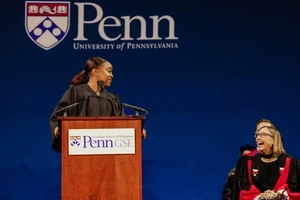
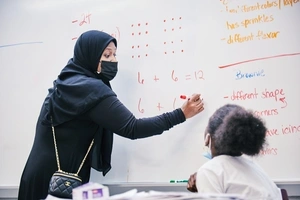
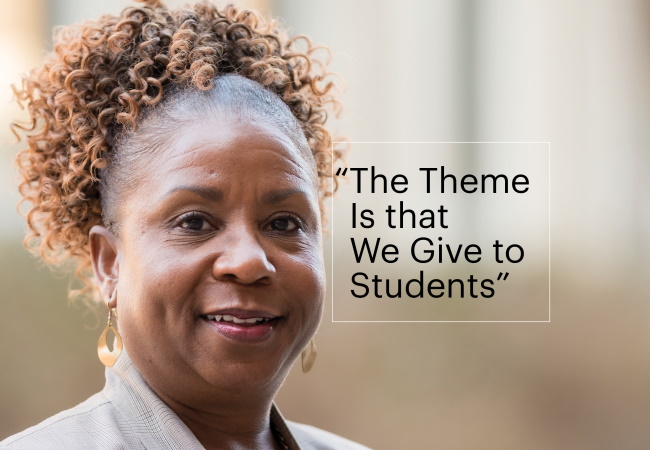
Tamir Harper, a teacher at the Henry C. Lea School and master’s degree student at Penn GSE, recently shared with Penn Today that although “it’s exhausting sometimes” and “a lot of pressure,” being a Black male educator “is an honor.”
The jobs of educators are among the most difficult to automate, Dr. James Lester said in a keynote celebrating the launch of the McGraw Center for Educational Leadership, but artificial intelligence (AI) still has massive potential to transform classrooms.
Richard Ingersoll says giving educators more authority at their workplace makes them feel like respected professionals; teachers need to be given a lot of discretion.
Richard Ingersoll identifies the primary causes of the teacher shortage–poor working conditions, low pay, and management issues–and discusses solutions to improve teacher retention.
Richard Ingersoll discusses teachers leaving the profession and how he arrived at his statistic that nearly half of educators quit within the first five years in a video interview.
Zachary Herrmann and Taylor Hausburg reflect on their Project-Based Learning for Global Climate Justice program and research project and are awarded a second year of funding through the Penn Environmental Innovations Initiative.
The Delaware Valley Consortium for Excellence and Equity helps middle and high school student leaders find their voices. The organization recently held its annual 2-day training for more than 700 students and faculty from 25 school districts.
It is not enough for students to learn information others have discovered; future workers in today’s knowledge economy need to become knowledge builders.
Dean Pam Grossman travels to Norway this week to celebrate her acceptance of the Doctor Honoris Causa award from the University of Oslo. She is the sole recipient of the school’s educational doctorate, while other industry leaders will receive the award for their work in areas such as law, medicine, and mathematics.
How bad is the teacher shortage? The answer depends on where you live, according to an article in the New York Times. Jacey Fortin and Eliza Fawcett spoke with experts and educators from across the country, including Richard Ingersoll.
Abby Reisman joins five other Philadelphia educators to discuss American history, equity and inclusion, critical race theory, and other hot-button issues schools and teachers face in 2022.
In its second year, the Office of School and Community Engagement's six-week summer program helps students with both academic difficulties and socio-emotional struggles.
The collaboration between Penn GSE and Temple University focuses on the facilitation skills needed to talk to students about history, civics, politics, and policy.
#PennGSEExperts Pam Grossman and Richard M. Ingersoll were interviewed for a recent Philadelphia Inquirer article about the looming crisis. Between 30 and 50 percent of new teachers now leave the profession after their first five years.
At a time of incredible flux, Penn GSE’s innovative leadership programs are helping create better school environments, amplifying the impact of K-12 leaders, shaping the future of higher education, and producing scholar-practitioners for the workplace.
A desire to build bridges, create educational access, and learn about different facets of education led these two students to pursue the Education, Culture, and Society program at Penn GSE.
Responding to the emerging needs of educators and leaders, Penn GSE’s Center for Professional Learning cultivates learning and connections that endure.
New faculty member and former superintendent Dr. Andrea Kane shares her expertise in instructional leadership, access and equity, and more, as she brings her perspective from twenty-five years in public schools to Penn GSE.
A pivotal moment in Penn GSE’s history, the groundbreaking ceremony for the School’s dramatic building expansion marked the start of a project that will fulfill a vision of 'One Penn GSE.'
Students, staff, and faculty from across Henry C. Lea Elementary School, the Penn Graduate School of Education, the Philadelphia Federation of Teachers, and the University of Pennsylvania gathered to celebrate a new era in the Penn-Lea partnership.
GSE Dean Pam Grossman and Lea Principal Aaron Gerwer answer questions about the partnership, its history, and their shared vision for prioritizing the needs and desires of the Lea community.
“Teaching Independence: Bridging the Communications Gap” brought educators from around the area together to discuss the complicated task of teaching race and its relation to America’s founding in a harshly divided political climate.
In partnership with co-authors from Brown University, Penn GSE’s Michael Gottfried has compiled an evidence brief providing strategies for combatting growing absenteeism numbers.
Janine Remillard speaks about a local program that prepares Black girls for careers in STEM fields. “Black girls need to be in an environment where they can thrive by being supported as learners, and by being able to look around and see others like themselves,” she says.
What can institutions do to help students make informed choices about higher education? How can we make sense of skepticism surrounding cost, value, and return on investment? Four members of the Penn GSE community at the forefront of these changes spoke at a recent Penn Alumni panel event.
Jonathan Zimmerman speaks about how teaching has been ignored until recently because “it has never been professionalized.” He says research has received more attention while teaching has gotten less, and suggests four guidelines for those considering peer review of teaching.
Struck by her own experience as an educator, Penn GSE alum Rina Madhani is helping promote childhood literacy in the underserved communities of the Bronx through a growing nonprofit.
Michael Gottfried speaks about mental health absences in schools. Unexcused absences can lead to truancy, get kids into trouble, get parents into trouble, and can lead to juvenile justice outcomes, he says. Schools need to keep careful track of students who take repeated mental health days.