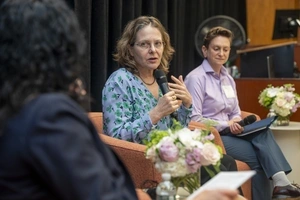
Student-athletes are cashing in on their name, image, and likeness like never before—creating ripple effects across campuses nationwide. At Penn GSE’s recent Homecoming panel, alumni experts unpacked what this billion-dollar shift means for recruiting, retention, and the future of higher education.
In The New Jersey Herald, Matt Hartley says that smaller universities routinely undergo structural reorganizations and that Montclair State’s centralization will likely lead to the creation of new administrative roles to guide decision-making.
In the Milwaukee Journal Sentinel, Robert Zemsky says that the three-year college model offers a more efficient alternative to traditional four-year programs, reducing academic waste by at least a quarter while maintaining educational quality.
In Memecita, Karen Weaver says that the NIL landscape is rapidly maturing, with collectives becoming more sophisticated, athletes gaining a clearer understanding of their market value, and colleges developing policies to support responsible NIL activity.
Karen Weaver says that other athletic conferences are likely to follow in the footsteps of the Big Ten, assuming they can successfully navigate a maze of thorny legal and political concerns.
Laura Perna says the net-price calculators that universities use when establishing the cost of attendance for students are not standardized and often misleading.
Karen Weaver says that new promotional strategies focused on impact and community from colleges are a great response to recent threats to college enrollment.
The vice provost for faculty and the GSE Centennial Presidential Professor of Education joins 24 scholars from across the country in the first class of fellows of the Association for the Study of Higher Education.
Vivian Gadsden has been appointed the vice president of the National Academy of Education. Dr. Gadsden co-directs the Penn Early Childhood and Family Research Center.
Dean Strunk says that developing strong partnerships is person-dependent and takes time to build trust and repair past areas that may be lacking in trust.
Laura Perna says that East Coast schools are more heavily featured among the best colleges in the country because many institutions in that part of the country were established long ago. She also mentioned population density as a factor leading to more schools on the East Coast.
Recent Global Higher Education Management program alumni Sarah Bauman-Kaye and Sasha Lussaint wrote a piece for "University World News" as a part of their capstone project, based on interviews conducted with Chinese high school students bound for undergraduate study in North America this fall.
Rapelang Rabana and Joe Wolf, Dr. Cathy N. Davidson, and Dr. Frederic Bertley are recognized for their pioneering contributions that have advanced learning opportunities and impacted countless lives.
Jonathan Zimmerman says that right-wing students are as eager as their left-leaning peers to censor allegedly ’problematic’ speech, and that And students across the political spectrum are biting their tongues, lest they incur the wrath of their opponents.
The program’s faculty includes a cadre of sought-after leaders in the field who live around the globe—from South Africa to the U.K.—and are able to come together in one classroom, thanks to technology.
Robert Zemsky says that much of the curriculum in a 4-year college model is unnecessary and is pushing for the normalization of a 3-year college degree.
John Silvanus Wilson Jr., a nationally recognized leader in higher education and former president of Morehouse College, has been appointed the next executive director of the McGraw Center for Educational Leadership at Penn GSE.
Julie Wollman says that low enrollment becomes a difficult calculus for higher education administrators who believe the major is important to offer but can't justify high overhead for professors to teach a very small number of students.
Robert Zemsky discusses the "wild" success of the College-in-3 movement, as well as some of the challenges it still faces, including resistance from some more traditional fields of study.
Penn GSE's Global Higher Education Management program is preparing the next generation of university leaders to thrive in a rapidly changing, interconnected world.
Penn GSE professors and programs are engaged in more than 150 international partnerships and projects in more than 60 countries around the globe. The goal? To change the world through education.
Jonathan Zimmerman says large research universities are the big losers in the Trump administration's endowment tax hike and questions why an institution like Penn should pay more than smaller elite colleges and universities.
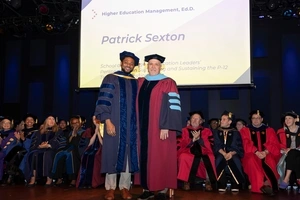
As he steps up his role from executive director to assistant dean for teacher preparation and undergraduate education, Sexton is using what he learned completing his executive doctorate over the last two years to “lean into strategic thinking.”
Penn GSE welcomed scores of alumni back to campus to celebrate, reconnect, and learn from a timely faculty panel about how educators can facilitate open and constructive classroom conversations during polarized times.
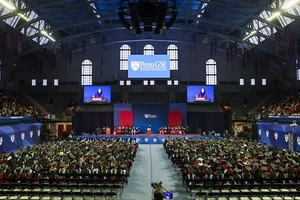
On May 17, in the Palestra, Penn GSE commemorated the achievements of the roughly 700 master’s and doctoral graduates at this year’s Commencement ceremony.
Julie Wollman notes that, "The pressures on a president are entirely different from a provost’s, given the public attention, the much heavier stress, and responsibilities," and speculates that Rutgers will choose someone who has already proven they can do the job for their next president.
Damani White-Lewis believes it is wrong to assume that a decline in white male professors is necessarily due to discrimination. He points out that the pool of candidates for academic positions–doctoral candidates and postdocs–has also become more diverse.
In The Key podcast, Karen Weaver discusses how recent NCAA policy changes, including NIL earnings, the transfer portal, and the House settlement, are reshaping college athletics and will have broad impacts across higher education.
Ross Aikins supports integrating AI into education, emphasizing that universities must evolve to prepare students for a future shaped by generative AI.
Robert Zemsky leads the College-in-3 Exchange initiative, which supports accelerated degree programs like BYU-Pathway’s as a means to “increase student success while decreasing student costs.”
Karen Weaver, a contributor to Forbes, reported that Judge Claudia Wilken delayed final approval of the NCAA’s $2.8 billion athlete pay settlement, highlighting concerns over new roster cap rules
Penn GSE alumni from across the academic spectrum have advised politicians, worked in the White House and the statehouse, and spurred change in our nation’s schools and universities thanks to their evidence-backed expertise in education policy.
Declining birth rates and rising tuition costs are making it difficult for small colleges to overcome enrollment declines, says Julie Wollman of the Graduate School of Education.
Laura Perna notes that students working over 20 hours a week tend to have lower academic performance, as limited time can hinder their success in college.
During an appearance on WHYY’s Studio 2 on March 18, Jonathan Zimmerman provided historical context for recent attacks on higher education, pointing out that critiques against the academy for a perceived left-wing bias go back more than 70 years.