
2027 Conference
For more information about the 2027 Conference details, please visit the website.
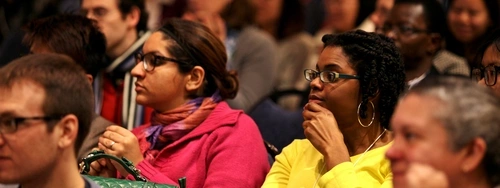
Convened by the Center for Urban Ethnography at Penn GSE since 1980, the Ethnography in Education Research Forum is internationally recognized for its encouragement of original and in-depth ethnographic research on education broadly defined, within and outside the context of schooling. The Forum provides a space for ethnographers in a range of disciplines and fields to come together across generations to share and learn from each other and, in so doing, to become part of a broader intellectual community. The Forum is committed to advancing systematic, rigorous, and engaged inquiry and to involving students in all phases of the meeting.
We would like to extend our heartfelt appreciation to the outgoing leadership team for their dedication and exemplary service in organizing our conference. They have been apt stewards of the conference, its legacy, and its mission to foster meaningful connections among participants. As we embark on a new chapter, we are excited to announce a seamless transition of leadership, ensuring continuity and fresh perspectives. Our focus now shifts toward charting an ambitious path forward, with plans to expand the conference’s scope and impact, promising an enriching experience for all attendees. We remain as dedicated as ever to sustaining the legacy of the Forum as the lead conference in the field of ethnography and education as well as an intellectual space that nurtures younger scholars and students. We look forward to sharing further updates on the Forum soon.
Forum Fast Facts
-
February 5-6, 2027 Next Conference Dates
-
Theme Worlds in the Making: Ethnography, Possibility and Finding Hope in the Field
-
April 15–June 15, 2026 Submissions open through this period
-
Location University of Pennsylvania, Graduate School of Education, Philadelphia PA
-
November 16, 2026–January 18, 2027 Registration
-
TBA Plenary and Keynote Speakers
Call for Papers 2027
Worlds in the Making: Ethnography, Possibility and Finding Hope in the Field
“The very act of trying to look ahead to discern possibilities and offer warnings is an act of hope.” —Octavia Butler
Futurists and authors of speculative fiction, like Octavia Butler, challenge us to imagine not only what is, but what might be. For the social scientist, the practitioner, and the policy leader, this requires a temporal imagination—a capacity to look beyond the immediate present and envision futures that are not yet realized. Yet, sociologically speaking, hope is never a neutral emotion. It is a situated practice, deeply embedded in historical, cultural, and political structures. It is shaped by the intersections of race, class, and gender, and it is frequently forged in the crucible of its shadow: despair.
In our current moment, hope itself is a site of struggle. What one community envisions as a hopeful future may be experienced by another as a profound loss or threat. These sometimes-irreconcilable visions of the future—political, educational, economic, and cultural—fragment our social landscape. And yet, even within these fractures, hope persists as a prefigurative force: a belief that new worlds can be built and that understanding across difference remains a radical possibility.
For 2027, the Ethnography Forum invites scholars to join us in exploring how hope is lived, contested, and cultivated. We invite proposals that relate to ethnography and build on the theme of hope.
- We are particularly interested in work that explores:
- Youth and the politics of aspiration: How do educational inequalities produce "foreclosed futures" or, conversely, sites of radical resistance?
- Institutional and structural hope: How do institutions manage (or stifle) the hopes of those they serve?
- Digital and global temporalities: How do digital spaces create new architectures for collective hope?
- The affective labor of the field: How do ethnographers navigate the emotional toll of witnessing both despair and hope?
We will be accepting papers from April 15 to June 15, 2026, for the conference held at the University of Pennsylvania on February 5 & 6, 2027.
Submission Information
Submissions open April 15 through June 15, 2026.
Forum Leadership and Staff


Graduate Assistants
- Sherry Lin (2024-2026), Master's Student in Higher Education
- Rashelle Johnson (2026-2027), Master’s Student in Education, Culture and Society.
- Yuetong Jiang (2024-2025), Master's Student in Education, Culture, and Society
- With special support (2024-2025) from Master's Students in Education, Culture, and Society, Felicity Breedlove and Hidy Li
- Lucia Mao (2023-2024), Master's Student in Education, Culture, and Society
- Zora Viel (2023-2024), Master's Student in Education, Culture, and Society
Our History
The Center for Urban Ethnography (CUE) was founded in 1969 with a major grant from the Center for Studies of Metropolitan Problems of the National Institute of Mental Health. CUE moved to the Graduate School of Education in 1976, where it undertook a series of funded research projects, including studies of urban literacy, urban neighborhoods, and a range of other urban issues. The expertise of the staff and faculty associates of the Center for Urban Ethnography is nationally recognized in the areas of practitioner research, ethnographic research design, school/community studies, qualitative evaluation and technical assistance, and monitoring classroom instruction and learning environments.
CUE first convened the annual Ethnography in Education Research Forum at the University of Pennsylvania Graduate School of Education in 1980. The Forum has from the beginning excelled in nurturing ethnographic research and researchers in schools. The Forum is known for its friendly and supportive atmosphere for fledgling researchers and for the spirit of relaxed and open dialogue embracing newcomers and oldtimers alike.
Practitioner Inquiry Day at the Ethnography Forum was initiated in 1987 by Marilyn Cochran-Smith and Susan L. Lytle – both assistant professors at Penn GSE at the time – and grew from the burgeoning interest in teacher research, action research, critical action research, and participatory research that was evident across the U.S. and internationally. From the beginning, the intent of Practitioner Inquiry Day was to provide a space for educators to share their research in various formats, including papers, symposia, data sessions, and informal group discussions. A number of featured speakers, groups, and individuals from around the U.S. and internationally have attended and presented during Practitioner Inquiry Day. Participants are K-12 teachers, community college and university teachers, public and independent school leaders, community organizers, social activists, and others who share a commitment to democratizing the discourse around teaching, learning, and leading to include the voices and ideas of a wider span of participants.
Practitioner Inquiry Day celebrated its 10th anniversary in 1997, its 20th in 2007, and its 25th in 2012, each time with a special program to acknowledge and explore the evolving movement of practitioner research. At its 20th anniversary, there was a memorable Reader’s Theater performance, “Practitioners’ Voices,” that highlighted the rich perspectives and diverse experiences of teachers, school leaders, and other educators whose inquiries explore teaching, learning, and schooling (Cochran-Smith & Lytle, 2009). In 2012, on the 25th anniversary of Practitioner Inquiry Day, Professor Gerald Campano initiated a midday Forum for presentations that focus on Communities of Inquiry. Special celebrations and events have marked milestones in Teachers College Press’ Practitioner Inquiry Series, which grew out of the Ethnography Forum’s Practitioner Inquiry Day, and each year there has also been a special display of books by and for practitioner researchers.
After more than three decades, Practitioner Inquiry Day remains faithful to its roots by providing a dedicated space for educators, practitioners, and community organizers to come together and inquire into, theorize, and collectively make meaning of their sites of practice.