Biography
Robert Zemsky has spent his career at the University of Pennsylvania focusing on how best to keep universities true to their missions while remaining market smart. He currently serves as chair of The Learning Alliance, a broad coalition of experts assisting institutions of higher learning in striking the balance between market success and public mission.
At Penn, Dr. Zemsky has been the university's chief planning officer and served as master of Hill College House. For 20 years, he served as the founding director of the university's Institute for Research on Higher Education, one of the country's major public policy centers specializing in educational research and analysis. In his research, Dr. Zemsky pioneered the use of market analyses for higher education.
Something of a contrarian, Dr. Zemsky recently described himself in the Chronicle of Higher Education as being "old and round enough to be mistaken for a pooh-bah." He was a member of the Secretary of Education's National Commission on the Future of Higher Education. He has forcefully argued that colleges and universities need to be transformed from within. He has focused on what globalism might really mean for higher education, on what technology has not accomplished, and on how to make learning important in the higher education marketplace. Dr. Zemsky has served as co-director of the National Center on the Educational Quality of the Workforce, as a senior scholar with the National Center for Postsecondary Improvement, as chair and convener of the Pew Higher Education Roundtable, and as senior editor for Policy Perspectives, a publication of the Pew Higher Education Research Program. He served as a founding member of the National Advisory Board for the National Survey of Student Engagement (NSSE). In 2008 he retired from the Board of Trustees of Franklin and Marshall College after 25 years of service. That same year he was elected to the Board of Whittier College, his alma mater.
Dr. Zemsky's international experience includes serving as a founding trustee of the International Centre for the Study of East Asian Development in Kitakyushu, Japan; as convener and chair of the Transatlantic Dialogue of educational leaders from Europe and the United States, sponsored by The Pew Charitable Trusts in cooperation with the American Council on Education and the Conference of European Rectors; as a senior consultant to the President and Parliament of Hungary; as a project consultant to the Ministries of Education in the Republic of Zimbabwe and the Republic of Egypt; and as a principal leader of United States-sponsored seminars in Tunisia and India. Dr. Zemsky played a major role in the Six-Nation Project on Global Education for the 21st Century sponsored by the University of Pennsylvania. This effort knit together working scholars and policy makers from China, Germany, Japan, Singapore, Switzerland, and the United States in a set of comparative studies that focus on topics important to the formation of national goals and policies for primary, secondary, and postsecondary education. He has served as a senior advisor to the University of Kobe, Japan and, in June 2003, joined the Glion Symposium. From June 2003 through July 2004, he served as a principal consultant to the Singapore Management University and in 2005 as a principal consultant to the National University of Singapore. In 2005 he also served as a Fulbright Senior Specialist in Vietnam. From August 2006 through May 2009, he served an auditor for the Australian Universities Quality Agency (AUQA). In 2009 Professor Zemsky served as senior consultant to the Higher Education Review Unit—Quality Assurance Agency for Education and Training, Kingdom of Bahrain and Senior Researcher for the Ministry of Presidential Affairs’ (MoPA) evaluation of the UAE's Education System's Outcomes and their Alignment with Labour Market Requirements.
Named in 1998 by Change magazine as one of higher education's top 40 leaders for his role as an agenda-setter, Dr. Zemsky is a former Woodrow Wilson Fellow and was a postdoctoral Social Science Research Council Fellow in Linguistics and later chair of that council's Committee on Social Science Personnel.
In 1998 he received a Doctor of Humane Letters (Hon.) from Towson University and in 2008 a Doctor of Humane Letters (Hon.) from Franklin and Marshall College. He holds a B.A. from Whittier College, and an M.A. and Ph.D. from Yale University.
Education
- Ph.D. (History) Yale University, 1966
- B.A. Whittier College, 1962
Areas of Expertise
- Market analysis for higher education
- Higher education reform
- Three-year college degree programs
Links
Research Interests and Current Projects
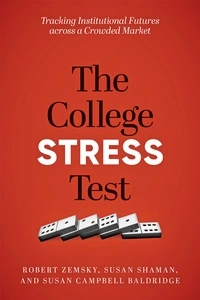
Dr. Zemsky’s most recent book, Communicate for a Change (Johns Hopkins University Press, 2021) with Lori Carrell of the University of Minnesota Rochester frames the kinds of discussions college and university must convene as a prelude to systematic change. His The College Stress Test with Susan Shaman and Susan Baldridge (Johns Hopkins University Press, 2020) is a higher education best-seller that analyzes market stresses that threaten the viability of some colleges and universities and provides a predictive tool to measure an institution's risk of closure. He is also the author of The Structure of College Choice (1982), Structure and Coherence, Measuring the Undergraduate Curriculum (1989), Higher Education as Competitive Enterprise: When Markets Matter (2001), Thwarted Innovation: What Happened to e-learning and Why with William Massy (2004), Remaking the American University: Market Smart and Mission Centered with Gregory Wegner and William Massy (2005), and Making Reform Work: The Case for Transforming American Higher Education (2009).
Publications
Featured Publications
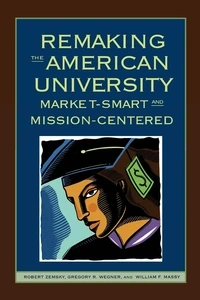
Remaking the American University
- Robert M. Zemsky
Rutgers University Press
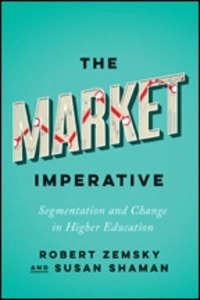
Market Imperative
- Robert M. Zemsky
Johns Hopkins University Press
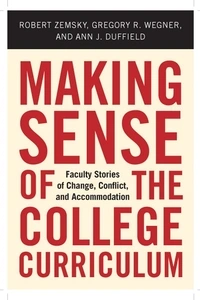
Making Sense of the College Curriculum
- Robert M. Zemsky
Rutgers University Press
The College Stress test: Tracking Institutional Futures across a Crowded Market
- Robert M. Zemsky
Johns Hopkins University Press
Checklist for Change: Making American Higher Education a Sustainable Enterprise
- Robert M. Zemsky
Rutgers University Press
The Market Imperative
- Robert M. Zemsky
Johns Hopkins University Press
Making Sense of the College Curriculum
- Robert M. Zemsky
Rutgers University Press
The College Stress test: Tracking Institutional Futures across a Crowded Market
- Robert M. Zemsky
Johns Hopkins University Press
Zemsky, R., Shaman, S., Baldridge, S. C. (2020). The college stress test: Tracking institutional futures across a crowded market. Johns Hopkins University Press.
Zemsky, R., Wegner, G. R., & Duffield, A. (2018). Making sense of the college curriculum. Rutgers University Press.
Zemsky, R., & Shaman, S. (2017). Market imperative. Johns Hopkins University Press.
Zemsky, R. (2009). Making reform work. Piscataway, NJ: Rutgers University Press.
Zemsky, R. (2008). The rain man cometh - again. Academy of Management Perspective, 22(1).
Zemsky, R. (2008). Has our reach exceeded our grasp? Taking a second look at higher education as a global enterprise. In L. E. Weber & J. J. Dunderstadt (eds.), The globalization of higher education. London: Economica, Ltd.
Zemsky, R., Wegner, G. R., & Massy, W. P. (2005). Remaking the American university: Market-smart and mission-centered. Piscataway, NJ: Rutgers University Press.
Zemsky, R., & Massy, W. (2004). Thwarted innovation: What happened to e-learning and why. The Learning Alliance.
Zemsky, R., Shaman, S., & Shapiro, D. (2002). Higher education as competitive enterprise: When markets matter. San Francisco: Jossey-Bass.
Zemsky, R., Shapiro, D., Iannozzi, M., Cappelli, P., & Bailey, T. (1998). The transition from initial education to working life in the United States of America. NCPI Project Paper #1.
Zemsky, R. (1989). Structure and coherence. Association of American Colleges and Universities.
Zemsky, R., Johnston, J., & Shaman, S. (1988). Unfinished design. Association of American Colleges and Universities.
Zemsky, R., & Meyerson, M. (1985). Training practices: Education and training within the American firm. Report to the National Institute of Education.
Related News
Robert Zemsky says that the transition of college programs from four to three years will be gradual.
- `
-
Robert Zemsky is highlighted as a thought leader and main proponent of behind college-in-3 initiatives.
-
Pennsylvania’s State Universities Will Consider Offering Three-Year Bachelor’s Degrees
In the Media | The Philadelphia Inquirer
Robert Zemsky says that many students are dropping out or transferring before completing four years of traditional college, hence describing the failing college model as "product rejection."
-
College in three years? A growing number of schools are considering it
In the Media | Pittsburgh Post-Gazette
Robert Zemsky's work in establishing the 3-year college model is cited in this piece.
-
Colleges are swiftly shortening bachelor degree programs to three years
In the Media | Los Angeles Times
Robert Zemsky says that a small number of institutions claim that the current model of college is not working and needs to be changed.
-
Robert Zemsky comments on three-year college degrees.
-
Robert Zemsky comments on the growing push for 3-year bachelor's degrees.
-
Three-year college degrees could be coming to some UW campuses
In the Media | Milwaukee Journal Sentinel
Robert Zemsky says that proposals to introduce three-year bachelor’s degrees at some University of Wisconsin campuses reflect a growing effort to reduce the cost and time required to complete college while maintaining the value of a traditional degree.
-
On Inside Higher Ed’s The Key podcast, Robert Zemsky says that three-year bachelor’s degrees could help colleges respond to declining student demand by offering a more efficient model.
-
Robert Zemsky says that momentum behind three-year bachelor’s degrees is growing as more states and colleges explore accelerated degree options to lower costs, improve affordability, and help students enter the workforce sooner, reflecting broader shifts in higher education models.
-
In The Boston Globe, Robert Zemsky says that Massachusetts’ move to allow colleges to propose three-year bachelor’s programs reflects a broader shift in higher education toward more affordable and efficient degree options that help students enter the workforce sooner while reducing the overall cost of earning a degree.
-
Robert Zemsky Says Three-Year Degrees Increase Efficiency and Reduce Waste in Higher Education
In the Media | Milwaukee Journal Sentinel
In the Milwaukee Journal Sentinel, Robert Zemsky says that the three-year college model offers a more efficient alternative to traditional four-year programs, reducing academic waste by at least a quarter while maintaining educational quality.
-
The battle over higher education
In the Media | Deseret News
Robert Zemsky says that much of the curriculum in a 4-year college model is unnecessary and is pushing for the normalization of a 3-year college degree.
-
Is the 3-year degree dream becoming a reality?
In the Media | Inside Higher Ed
TopicsRobert Zemsky discusses the "wild" success of the College-in-3 movement, as well as some of the challenges it still faces, including resistance from some more traditional fields of study.
-
Topics
The Boston Globe’s editorial board praises Robert Zemsky’s College-in-3 initiative and advocates for Massachusetts regulators to allow colleges and universities to begin rolling out more three-year bachelor’s degree programs.
-
The Three Year College Degree
In the Media | The American Spectator
Robert Zemsky notes that the four-year curriculum expresses the preferences of faculty rather than students or parents.
-
B.A. for $6K: BYU-Pathway pioneers three-year degree for four-figure price tag
In the Media | The Washington Times
Robert Zemsky leads the College-in-3 Exchange initiative, which supports accelerated degree programs like BYU-Pathway’s as a means to “increase student success while decreasing student costs.”
-
Bob Zemsky advocates for a three-year college degree model, emphasizing cost reduction, improved retention, and a focus on essential learning.
-
UArts’ sudden closure was a shock, but not a big surprise in the turbulent higher-ed landscape
In the Media | The Philadelphia Inquirer
TopicsRobert Zemsky says that the richest and biggest institutions of higher education will continue to prosper while small and vulnerable schools go out of business.
-
Robert Zemsky says that too few small institutions like the University of the Arts are efficient enough to survive without outside subsidies.
-
Zemsky advocates for a shift to three-year degree programs to combat the rising costs and evolving needs of higher education.
-
Robert Zemsky spearheaded a national initiative to pilot three-year bachelor’s degrees with fewer than 120 credits, aiming to reduce college costs and accelerate workforce entry. The initiative has influenced about 20 schools to consider adopting more accessible and efficient higher education models.
-
Topics
Robert Zemsky advocates for a new approach to three-year college degrees, which involves fundamentally redesigning undergraduate curricula to reduce the total required credit hours, allowing students to complete their degrees in three years while still enjoying a full college experience.
-
Emporia State Cut Tenured Faculty. Enrollment Plunged.
In the Media | Inside Higher Ed
Robert Zemsky highlights a broader trend of devaluation in higher education and the challenges faced by institutions cutting faculty positions and programs, suggesting that only top-tier universities are thriving while others are struggling.
-
Praying for a merger miracle
In the Media | Inside Higher Ed
Robert Zemsky questions the effectiveness of mergers like Vermont State University's consolidation of three struggling colleges in addressing core issues faced by these institutions.
-
Robert Zemsky shares recent successes of “College in 3” project in “The Hechinger Report” and “USA Today”
News |
TopicsThe project's first 3-year degree pilot recently launched at the University of Minnesota Rochester, one of more than a dozen colleges and universities planning similar programs with the project. The idea of a 3-year bachelor’s degree is on track to become ubiquitous, Zemsky says.
-
Susan Basso awarded 2023 Zemsky Medal for Innovation at Penn GSE’s Higher Education Leadership Conference
News |
TopicsThe annual event draws educators from around the country for a 3-day conference focused on equitable outcomes. Program alum Lawrence P. Ward and Dean Pam Grossman also received awards for their leadership.
-
Robert Zemsky’s work with 13 higher education institutions to create three-year programs is highlighted
-
Momentum builds behind a three-year degree to lower college costs
In the Media | The Washington Post
Robert Zemsky is quoted on the worries that speeding up curriculum to graduate from college in three years would “cheapen the degree.”
-
Topics
Penn GSE’s Robert Zemsky, an expert on higher education, is leading a new project called “College in 3” to explore the feasibility of creating intentional three-year degree programs.
-
Penn GSE’s Bob Zemsky detailed how many colleges were close to the financial brink just before the pandemic hit. Here’s what he says colleges face in the next year and beyond.
-
Robert Zemsky said, in the face of the pandemic, colleges with 1,500 or fewer students are facing the question of how much they can shrink and continue to function.
-
College students want answers about fall, but schools may not have them for months
In the Media | The Washington Post Online
Robert Zemsky said, “It’s revenue pressure, and the sense that ‘if we’re the one that doesn’t open, we lose our share of the market permanently.’”
-
Coronavirus pushes colleges to the breaking point, forcing ‘hard choices’ about education
In the Media | The Wall Street Journal
In his book The College Stress Test, Robert Zemsky predicted that 10% of private, liberal arts colleges in the U.S. were likely to close within the next five years. Now, with the pandemic’s damaging effects on school finances, his prediction has changed to 200 schools in the next year alone.
-
Robert Zemsky, in his new book, The College Stress Test, estimates that 10 percent of the nation’s colleges – smaller schools with poor retention rates – were already at risk of closing. Now, he said, “we think another 10 percent is at risk because of the virus.”
-
The bailout is just the start: Why higher ed needs to build a sustainable model
In the Media | The Chronicle of Higher Education
Robert Zemsky said that “dislodging events,” such as COVID-19, can force needed changes in education.
-
Will Coronavirus Close Your College for Good?
In the Media | The Chronicle of Higher Education
TopicsFor 20 percent of institutions, this may be an existential moment, says Robert Zemsky.
-
The Oddsmakers of the College Deathwatch
In the Media | The Chronicle of Higher Education
Robert Zemsky discusses market pressures of higher education and his book, The College Stress Test. The conversation around what is happening in higher ed is “caught among extreme visions.” Necessary innovations for systemic change are difficult to pull off, he says.