By Rashelle Johnson
On a strikingly cold February day in Philadelphia, I woke up before the sun, excited to see months of hard work come to fruition. By the time the first attendees arrived for the 2026 Ethnography in Education Research Forum, I had already been awake for hours, drinking coffee, setting up, preparing volunteer stations, and mentally preparing for a long, yet exciting, day. For months, I had worked hard as part of the Forum Team, helping organizers prepare for and publicize the event. My days up until that point had been measured by emails, spreadsheets, outreach, and volunteer coordination. Today, I would get to see the results of that work.

I am a master’s student in both the University of Pennsylvania's Graduate School of Education, studying Education, Culture, and Society, and the School of Social Policy and Practice, studying Nonprofit Leadership. Long before anyone took a seat in a panel room, and long before the Forum officially began, it had already become a part of my daily life. Some of the tasks I worked on included managing social media outreach, contacting universities and organizations across the region, coordinating volunteers, and, of course, brainstorming ways in which we could create a space that felt welcoming, thoughtful, and intellectually alive.
The Ethnography in Education Research Forum, convened by the Center for Urban Ethnography and hosted by Penn GSE, is an internationally recognized conference that has served as a space for scholars and students alike to engage deeply with ethnography since 1980. It’s one of the longest-standing spaces of its kind in the field and has invited researchers, educators, practitioners and students to engage with work that digs deep into lived experiences.
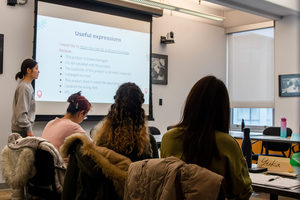
This year’s theme, #FACTS: Constructing Knowledge and Truth in a Complex World, was incredibly timely. Over two full days, the Forum hosted a rich collection of panels, sessions, data consultations, and presentations that asked how ethnographers define, interpret, and challenge what we call “facts”. There were also four keynote speakers—Harvard’s Gabriella Coleman, Princeton’s Laurence Ralph, University of Chicago’s Kimberly Kay Hoang, and Hamilton College’s Chenyu Wang—and over 200 panels and sessions across the two days.
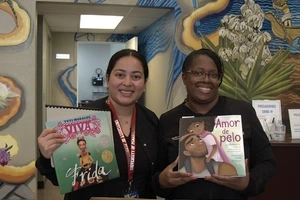
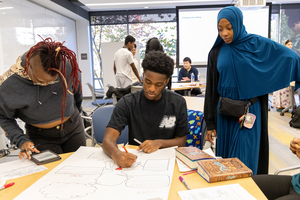
My own experience of the two days unfolded largely behind the scenes. I spent much of the Forum coordinating volunteers and ultimately ensuring the logistics ran as smoothly as possible with the rest of the team. Uniquely, I had the privilege of experiencing the conference through the people moving through it, checking in at registration, greeting attendees, engaging with everyone I could. Some were my friends from Penn GSE, some were volunteers I had never met before, some were attendees all the way from Brazil to the Czech Republic! The rhythm of the Forum was impossible to miss. Whether in sessions, crowded in hallways, lingering in classrooms, conversations and connections spilled over. I saw the energy of the Ethnography Forum in the way attendees shared and interacted with one another.
One of our volunteers, Benji Aliaga, captured this spirit perfectly. He wrote that while the Saturday morning keynote with Gabriella Coleman was especially intriguing, what he took away most were the connections he was able to make, whether meeting new people across GSE or engaging with visiting scholars and educators.
“Volunteering at the Forum not only exposed me to interesting research involving ethnography in education”, he said, “but also enriched my day-to-day experience at GSE through these new connections.”
Hearing reflections like this reminded me that the Forum isn’t just a list of sessions and panels on a program schedule, but a relational space—a space meant for connection and where ideas are sparked not only in formal settings, but in conversation, shared meals, and moments of recognition across different disciplines. Even as an organizer, seeing this unfold felt like I got to sit in on a session myself.
Organizing the Forum reaffirmed something I have also connected with ethnography, which is that it’s a practice of human connection as much as it is intellectual inquiry. This past weekend highlighted a place where knowledge was produced together, not just presented. It was such a privilege and an honor to contribute to creating that space, and it leaves me thinking deeply about what it means to build communities of inquiry.
Media Inquiries
Penn GSE Communications is here to help reporters connect with the education experts they need.