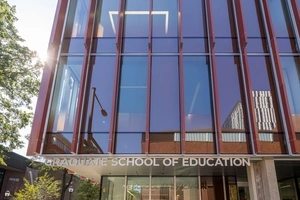
It’s been another busy year. For Penn GSE, 2025 marked a year of impactful research, new faculty faces, and an increased focus on AI in education. Our most-read stories this year spanned all these topics and more. From a convening in partnership with the Pennsylvania governor’s office to a million-dollar expansion of a program that helps teachers and school leaders navigate the rapidly evolving landscape of AI, Penn GSE has continued to push the envelope on education innovation. Read on to look back at the School’s biggest news this year.

1. New Teacher-Staffing Model Effectively Combats Troubling Teacher Retention and Turnover Challenges
As schools across the nation grapple with the challenges of hiring and retaining teachers, Penn GSE Professor of Education and Sociology Richard Ingersoll worked with researchers from Arizona State University to study a “NEW” model of teaching.
The Next Education Workforce (NEW)™ initiative rethinks traditional classroom models by integrating teams of teaching staff who share a roster of students and multiple learning spaces. Teams collaboratively plan instruction with each member taking on different roles and responsibilities. The model also elevated teacher decision-making authority. Ingersoll called the results of the study “startling.”
2. Is That AI System Fair? New High School Curriculum Helps Students Find Out

Last month, Penn GSE announced a pioneering set of curricular materials aimed at equipping high school students with the tools to critically examine algorithmic bias in artificial intelligence (AI) systems.
Developed by Yasmin Kafai, the Lori and Michael Milken President’s Distinguished Professor, in collaboration with Assistant Professor Danaé Metaxa from Penn’s Computer and Information Sciences department and high school computer science educators across the country, the “AI Auditing for High School” curriculum introduces students to the concept of algorithmic bias and guides them through hands-on audits of real-world AI applications—no coding experience required.
Read the full story to access the materials and learn more about this new curriculum.
3. New Faculty Member Shiyan Jiang on Bringing AI to Every Classroom

As one of Penn GSE’s newest faculty members, Shiyan Jiang is helping expand what AI education can look like—and who it’s for. She doesn’t believe AI should be confined to computer science classes or taught only by tech experts. Instead, she’s designing curriculum and professional learning that help educators across all subjects bring AI into their classrooms in ways that are accessible, meaningful, and rooted in identity. In this Q&A, Jiang shares her vision for inclusive AI education, what drew her to Penn GSE, and why she believes every teacher can be an AI educator.
As a bonus, check out our Q&A with our other new AI-expert faculty member, Seiji Isotani, a global leader in intelligent tutoring systems who develops AI tools that adapt to the needs of students and teachers—especially in under-resourced settings.

The McGraw Center for Educational Leadership got some fresh leadership of its own this year, welcoming nationally recognized higher ed leader John Silvanus Wilson, Jr. as its new executive director. A Philadelphia native, Wilson returned to his hometown with extensive higher ed leadership experience under his belt. He helped establish the Open Leadership Project at MIT’s Media Lab and has served as executive director of the White House Initiative on Historically Black Colleges and Universities under President Barack Obama, president of Morehouse College, and senior adviser and strategist to two Harvard University presidents.
In his new role, Wilson will guide the McGraw Center in expanding its reach, strengthening partnerships, and equipping the next generation of leaders with the skills, mindsets, and values needed to address today’s most pressing challenges in education.
5. Penn GSE Welcomes Eric Hartman as New Leader of Higher Ed Doctorate Program

In addition to our new AI experts and Wilson, Penn GSE welcomed some other new faces over the summer. Eric Hartman came on board to take over leadership of the Executive Doctorate in Higher Education Management program. Hartman was most recently at Haverford College, where he served as executive director of the Center for Peace and Global Citizenship for nine years. He also has experience with nearly every type of higher education institution: community colleges, regional public universities, land-grant institutions, faith-based colleges, liberal arts institutions, and Ivy League schools.
The School also appointed Laurie Hall—herself an alum of the executive doctorate program—as vice dean of executive programs. In this role, Hall provides overall leadership, direction, and support for the continued development of the school’s popular executive format programs. Her work is rooted in data-driven decision making, mission alignment, and collaboration.
6. Penn GSE Launches Algebra 1 Fellowship to Strengthen Math Teaching in Philadelphia Schools

With funding from the Neubauer Family Foundation, Penn GSE launched the Algebra 1 Fellowship for School District of Philadelphia educators in direct response to the school district’s call for targeted support in Algebra 1 instruction. The initiative has a particular focus on research-driven teaching strategies that align with the district’s Illustrative Math curriculum.
The program already held its first sessions this summer and fall, garnering a great deal of interest among Philadelphia’s eighth- and ninth-grade algebra teachers.
7. Penn GSE Co-Hosts "AI for Public Good" Statewide Convening

Continuing our leadership on AI in education, Penn GSE co-hosted an on-campus event in partnership with the Office of Pennsylvania Governor Josh Shapiro titled “Unlocking AI for the Public Good.” The landmark event spotlighted the critical role of higher education in shaping ethical, evidence-based AI policy and practice
At the event, University President J. Larry Jameson announced a new formal cooperative AI-advising agreement with the Commonwealth of Pennsylvania.
8. Winners Announced for 2025 Milken–Penn GSE Education Business Plan Competition

In September, fair chance hiring compliance venture Rézme captured the $40,000 Michael & Lori Milken Family Foundation Grand Prize and earned the most live votes to also win the Audience Choice Prize presented by EdSales Elevation Experience at the 16th annual Milken–Penn GSE Education Business Plan Competition (EBPC) in New York City. The software dismantles systemic barriers keeping justice-impacted individuals from jobs, housing, and higher education.
The venture entered the competition last year but left empty-handed, making this year’s return a comeback victory for the team led by co-founder and CEO Jodi Anderson, Jr.
9. Penn GSE’s PASS Program Receives $1 Million from Google to Expand AI Education in Schools

Originally launched in spring 2025 as a pilot in the School District of Philadelphia with foundational support from the Marrazzo Family Foundation, the Pioneering AI in School Systems (PASS) program began scaling the model to a national level this fall thanks to $1 million in funding from Google.org, Google’s philanthropic arm.
The AI professional development program partners with school districts to build internal expertise, align local policies with emerging AI standards, and promote responsible, equitable innovation, working directly with teachers on topics like access, data privacy, model bias, and ethical implementation.

10. Penn GSE Rises in U.S. News Rankings
Penn GSE climbed to #6 in the 2026 U.S. News & World Report rankings of graduate education programs, up from #7 last year. Notably, the School has been in the top 10 for the last 13 years. This recognition underscores our continued leadership in the field and commitment to advancing educational research, policy, and practice.
Honorable Mentions
- “The Academy at Penn” Names High School of the Future and Horace Howard Furness High Schools for Philadelphia College and Career Readiness Program
- Truth Mjumbe Launches AI-powered Tool to Preserve Memory and Dignity
- Educator’s Playbook: Tips for Creating Contemporary Lesson Plans with AI
- Educator’s Playbook: Incorporating Arts-Based Inquiry into Literacy Classrooms
- Library of Congress Literacy Awards Honor Penn GSE-Related Literacy Initiatives
Media Inquiries
Penn GSE Communications is here to help reporters connect with the education experts they need.