Faculty Expert
-

Zachary Herrmann
Senior Director of Strategic Initiatives
Learning, Teaching, and Literacies Division
How can educators develop future leaders with a focus on the public good? What does it mean to incorporate character-based leadership values into everyday instruction in any discipline? These are the questions the Penn Leadership Education Institute aims to answer.
The Penn GSE-based initiative is led by Senior Director of Strategic Initiatives Zachary Herrmann, who serves as the principal investigator on the project. Part research institute, part professional development program, the initiative investigates and promotes the integration of character-based leadership values and practices into classrooms through student and faculty fellowships and symposiums.
The Institute is funded by an Institutional Impact grant from the Educating Character Initiative, awarded by Wake Forest University’s Program for Leadership and Character and made possible through the generous support of the Lilly Endowment Inc.
Discussing the significance of the initiative, Herrmann referenced a recent TIME study ranking Penn among the top three universities graduating leaders across industries.
“All of our students have a meaningful impact on the world,” Herrmann said. “It raises the question: What can we do while they’re here to prepare them—not only for their own success, but for the betterment of the institutions and communities they will serve?”
The Institute’s goals align with Penn’s strategic framework, In Principle and Practice, the University’s values statement, and Penn GSE’s strategic vision, Together for Good, all of which emphasize developing leaders who improve the world around them.
The initiative advances character-based leadership at Penn and beyond through three interconnected initiatives: the Penn Faculty Fellowship, the Penn Student Fellowship, and symposiums and workshops open to educators outside of Penn.
Through the faculty fellowship, instructors across Penn learn to weave leadership values into their teaching, while the student fellowship engages undergraduates in putting those values into practice. The symposiums and workshops amplify this work, bringing the insights uncovered through the fellowships to educators far beyond campus.
Each cohort explores a different leadership value, with student fellows one value ahead of the faculty cohort. This fall, the faculty fellows are examining the value “enhancing social good,” while the spring cohort will turn to open-minded and curious leadership—a value this semester’s student fellows are already studying. By sequencing the work this way, insights the students generate feed directly into the faculty’s exploration, creating a meaningful feedback loop between the cohorts. Herrmann explained that this structure “builds a whole ecosystem of development around these values.”
Cohorts tackle each value holistically through three broad strategies: cultivating an inclusive learning environment; modeling, discussing, and critiquing exemplars of each value in action; and creating practice and reflection opportunities—going beyond learning about it and talking about it to actually practicing it.
Several current faculty participants touted the opportunity to collaborate with colleagues from across the University, breaking down silos and engaging in honest dialogue.
Catherine Bartch, associate director of the Center for Latin American and Latinx Studies at Penn Arts & Sciences, said the institute “provides you an opportunity to deeply reflect on how you teach, which is something that is often lacking from many Ph.D. programs and academic fields,” and that it helped her “think critically about how to be a better educator.”
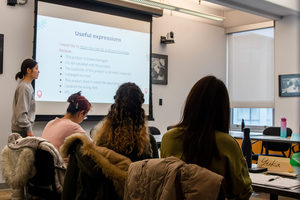
She highlighted the demonstrations of classroom activities and both formal and informal discussions with other faculty as particularly helpful, adding that she plans to implement some of the activities and techniques for engaging students shared by other attendees.
Michelle J. Johnson, an associate professor in physical medicine and rehabilitation and director of the Rehabilitation Robotics Lab at Perelman School of Medicine, called it an “excellent opportunity to critically examine how your syllabus adheres to the university goal of imputing the social good.”
Herrmann emphasized that students are always implicitly learning lessons about leadership values and practices, and it’s up to educators to be mindful about what lessons their students take home from class with them.
“Our goal is to help faculty integrate leadership development into their courses, regardless of the subject matter they teach,” he said. “Essentially, we believe that everyone is teaching leadership. The question is: how intentionally are we doing that?”
The fellowship has already drawn wide interest and generated powerful insights from its early cohorts. Registration is open for the January Introduction to Negotiations virtual workshop and February’s Leadership Education Global Symposium on campus at Penn GSE. All faculty and undergraduate inquiries—whether for the Spring 2026 faculty fellowship, future cohorts, or student fellowship opportunities—can be submitted through the program interest form available on the website.
Media Inquiries
Penn GSE Communications is here to help reporters connect with the education experts they need.