What sort of education prepares individuals to lead with creativity, curiosity, humility, and a focus on social good? What sort of education nurtures the types of leaders our communities deserve? These are the fundamental questions we seek to explore through the Penn Leadership Education Institute.

Zachary Herrmann, Senior Director of Strategic Initiatives

About the Penn Leadership Education Institute

The Penn Leadership Education Institute researches, designs, and implements innovative approaches for educators to shape the next generation of thoughtful, capable, and impact-driven leaders.

Open to K-12 and higher education educators and leaders worldwide, the Educator Fellowship for Student Leadership is a year-long virtual fellowship designed to bring together teacher leaders, department chairs, and school and system leaders who are committed to cultivating student leadership in their classrooms, schools, and systems.

Designed for current Penn faculty and students, the Penn Faculty Fellowship and Penn Student Fellowship are cohort-based learning experiences for Penn faculty and instructors seeking to embed character and leadership education into their academic courses and Penn undergraduate students interested in exploring value-based leadership development. 

Circle Graphic of the PLI Framework

Our Leadership Values Framework

At the Penn Leadership Education Institute, we believe that developing leaders of character requires intentional focus, interdisciplinary thinking, and practical application. Our work is grounded in five core University values that guide how we design learning experiences—for faculty, instructors, and ultimately, students.

Each value represents a dimension of character-based leadership, and each prompts critical reflection about how educators can embed these ideas into their own teaching practice. 

To support this work in practice, we have identified classroom-ready strategies and instructional moves associated with each value that can be adapted across disciplines and learning contexts. Read on to explore each value in depth, alongside guiding questions, example strategies, and resources for bringing character-based leadership into your own teaching.

Relentlessly Focused on Enhancing Social Good

Leaders lead in service of their communities, organizations, and societies. Leaders focus on improving conditions for others, addressing pernicious problems, and building a more just and inclusive society for all. 

Ask Yourself…

  • How might we support students to embrace an active role in improving conditions within their community or society?
  • How can we lead students to collaborate and problem solve across divisions and divides?
  • How am I encouraging students to reflect on the social issues they care most about, and develop intentions for addressing them?

Try This… 

  • Invite students to define what “social good” means to them, in their specific context, before applying it to course material. This broadens the concept beyond a single perspective. 
    • You can also return to this definition throughout the course, asking how it holds up as students learn more.
  • Connect student work to real people, problems, and communities beyond the classroom. This might include:
    • Requiring students to identify and learn from the real-world stakeholders affected by the problems and solutions they explore in class
    • Partnering with a community organization to ground student work and learning in authentic, local challenges
    • Inviting stakeholders in as guest speakers or collaborators for student work
  • Design culminating projects that ask students to propose and implement actionable solutions and examine their wide-ranging implications for different stakeholders.
  • Weave social good-oriented questions consistently throughout the course so that students begin raising them independently.
Open-minded and Curious 

Leaders are open-minded and curious. They ask big questions and seek new perspectives. They are humble and eager to learn and grow. They engage in earnest with others, even when they see things differently. They seek to deepen their own understanding, not prove they are right. 

Ask Yourself...

  • How might we support students to ask and explore big questions?
  • How can we lead students to test, challenge, and refine their ideas and perspectives?
  • How am I encouraging students to engage in challenging topics with others who think differently, in the interest of constructing new insights, knowledge, and understandings?

Try This...

  • Treat students' ability to ask deep, insightful questions as a core learning outcome— not just their ability to produce correct answers, and design instruction and assessment accordingly. This may include:
    • Beginning each class with a student-generated question that opens inquiry rather than closes it
    • Asking students to write down their questions at the start of a unit and again at the end, so they can see how their thinking has evolved over time
  • Regularly share with your students the questions you are still sitting with as you move through the course, modeling curiosity as an ongoing process rather than a problem to be solved.
  • Structure activities such that students are asked to engage seriously with perspectives they disagree with or may not have considered otherwise, and debrief what they learned from doing so.
  • Name and explore moments of disagreement or confusion openly, rather than resolving or smoothing them over. This can help model for students the idea that tension is a productive part of thinking.
    • When discussion breaks down or slows, pause and invite students to diagnose why and what might help
  • Ask students to regularly find and share connections between course material and the world beyond the classroom, giving them ownership over what feels meaningful and relevant.
Inventive and Practical

Leaders notice, analyze, and confront complex problems. They create opportunities. They find new ways to address old challenges, and they focus on making things work in both principle and practice. 

Ask Yourself...

  • How might we support students to identify, explore and construct solutions to thorny problems?
  • How can we lead students to utilize creativity, innovation, and critical thinking to construct new ideas in service of real problems and opportunities?
  • How am I encouraging students to consider the impact their ideas might have on the world?

Try This...

  • Bring real problems, cases, practitioners, and stakeholders into your class so students practice applying their thinking to authentic, nuanced, and thorny challenges. 
  • Lead students to deeply understand real problems and opportunities before collaborating to design, prototype, test, and iterate solutions that are co-designed with the communities they look to serve. 
  • Push students to anticipate the consequences and tradeoffs of their ideas, including for people and communities beyond the immediate context they’re studying or designing for.
Imperfect but Self-Improving

Leaders are self-aware of both their greatest strengths as well as their greatest areas for growth. Leaders are humble enough to appreciate their shortcomings, and bold enough to chart a path toward improvement. Leaders are resilient and mindful, and gracious with themselves and others.

Ask Yourself...

  • How might we support students to engage in cycles of feedback, reflection, and revision, creating opportunities for students to better understand their strengths and shortcomings?
  • How can we lead students to develop a productive sense of self, resilience, grace, and perspective?
  • How am I encouraging students to set and pursue meaningful goals?

Try This...

  • Build structured opportunities for students to set goals, reflect on their progress, and revisit their thinking across the full duration of the course. For example:
    • Invite students to track their learning through journals, self-surveys, or reflection prompts that ask them to notice how their thinking is shifting
    • Hold brief individual or small-group check-ins mid-semester to hear how students are experiencing the course
  • Incorporate multiple rounds of peer and self-assessment throughout a project, so feedback becomes part of the learning process rather than a verdict at the end.
  • Model your own imperfection and curiosity as an instructor. For instance:
    • Share what questions the material raises for you, what you're still uncertain about, and how your thinking is shifting alongside theirs.
    • When activities don't go as planned, reflect together openly, showing students that revision and learning from setbacks are central to growth rather than signs of failure.
       
Exhibiting Brilliance Across Fields

Leaders understand the power, and the limitations, of their disciplines to make sense of the world. Different disciplines and fields each shed light on unique aspects of complex issues. Leaders appreciate that most pressing challenges cross boundaries. Therefore, leaders call upon expertise from a wide spectrum of sources and embrace innovation and interdisciplinary problem-solving to address these challenges. 

Ask Yourself...

  • How might we support students to understand the power, and limitations, of your discipline or field?
  • How can we lead students to leverage your field’s tools and approaches in wise, thoughtful, and ethical ways?
  • How am I encouraging students to explore and utilize interdisciplinary approaches to complex problems?
  • How can I support students in collaborating across disciplinary boundaries?

Try This...

  • Be explicit about what your discipline does and doesn't illuminate, modeling the intellectual honesty and intellectual humility that genuine expertise requires.
  • Design assignments that ask students to draw on frameworks, methods, or perspectives from outside your field to deepen their analysis.
    • This could be done as a dedicated component of key assignments, or through standalone reflection prompts
  • Bring in practitioners or collaborators from adjacent fields to engage with students, surfacing how different disciplines approach shared problems.


Our Ongoing Programing

Our ongoing programming includes the Educator Fellowship in Student Leadership, the Penn Faculty Fellowship in Student Leadership, and the Penn Student Fellowship in Student Leadership. Learn more and apply to join our upcoming cohorts.

Educator Fellowship in Student Leadership

Open to educators and educational leaders worldwide, the Educator Fellowship in Student Leadership is a year-long, virtual professional learning experience bringing together teacher leaders, department chairs, and school and system leaders committed to cultivating student leadership in their classrooms, schools, and systems. Through a series of monthly interactive webinars, Educator Fellows engage with key dimensions of student leadership development, including cultivating supportive learning environments, integrating leadership into curriculum, and designing opportunities for student practice and reflection. 

Program Details & Application – Apply by August 1, 2026
Five women standing in a circle having a conversation

At the core of the Fellowship is a sustained community of practice that brings together educators from diverse educational contexts. Fellows learn alongside one another, sharing experiences, exchanging strategies, and collectively problem-solving challenges related to implementation. 

Each session combines research-informed insights with opportunities for collaboration, enabling participants to connect ideas to their own contexts and develop actionable plans. Between sessions, participants are encouraged to apply new approaches in their contexts, using their real-world experiences as a foundation for ongoing learning. Across the year, fellows engage in cycles of learning, planning, implementation, reflection, and refinement, ensuring that leadership development is deliberate and intentional. By the end of the fellowship, participants will have developed a clear and context-specific vision for student leadership, along with a set of concrete strategies to support students in developing the skills, dispositions, and habits of effective leaders.

Now Accepting Applications for the 2026–2027 Educator Fellowship in Student Leadership

Individual and team memberships are available, and you can learn more about the individual and team membership options, session dates, program application details, and apply by August 1 to join us this September.

Learn More & Apply

Penn Faculty Fellowship in Student Leadership

A cohort-based learning experience designed for Penn undergraduate faculty and instructors seeking to embed character and leadership education into their academic courses. Through a faculty-centered professional learning program, the Faculty Fellowship fosters cross-disciplinary collaboration, enriches teaching practice, and cultivates a shared vision for developing future leaders. 

Program Details & Application

Faculty participants engage in a collaborative learning community, where they explore frameworks for character development, design course-aligned learning experiences, and contribute to a growing network of educators committed to holistic student development.

Over time, this initiative aims to support institutional coherence around leadership education and inspire similar efforts across the field of higher education.

Learn More & Apply

Penn Student Fellowship in Leadership Development

The Student Fellows program is a cohort-based, cross-disciplinary learning experience designed for Penn undergraduate students interested in exploring value-based leadership development. 

Program Details & Application
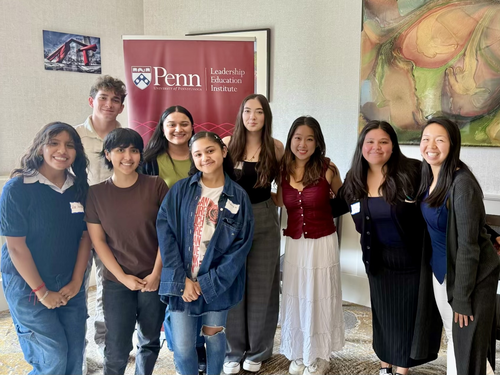
A group photo of 10 students in the Penn Leadership Institute

Student Fellows engage in a collaborative learning community, where they explore frameworks for leadership development, reflect on personal leadership values, and generate student-driven insights to inform the work of the Penn Leadership Education Institute, including the Faculty Fellows program. The fellowship aims to amplify student voices in shaping the future of leadership education at Penn and beyond.

Learn More & Apply

Custom Programs and Partnerships

The Penn Leadership Education Institute partners with and offers custom professional development and consulting services for schools, districts, systems, and organizations to build and articulate ambitious visions for student leadership, and design and implement strategies for pursuing those visions.

We offer flexible engagement models, from fully virtual programs and on-campus retreats, symposiums, and workshops, to on-site professional development at your school or organization– let us know your preferences in a request for proposal, and we'll follow up with a customized plan for how we can help you achieve your professional development and strategic planning goals.

Proposal Request


A Collaborative Approach to Character and Leadership Development

The Penn Leadership Education Institute takes a collaborative, research-informed approach to character and leadership development, grounded in the belief that preparing students to lead with integrity, empathy, and purpose begins with supporting their educators. This initiative is designed to empower educators to intentionally integrate character-based leadership education into their academic teaching.

The Institute conducts novel research on character-based leadership development, and designs and delivers innovative programs that support educators and students to define and pursue ambitious leadership visions.

The Penn Leadership Education Institute is funded by an Institutional Impact grant from the Educating Character Initiative (ECI), awarded by Wake Forest University’s Program for Leadership and Character and made possible through the generous support of the Lilly Endowment Inc. This grant program is designed to strengthen the integration of character education within undergraduate institutions nationwide.

Penn Leadership Education Institute Logo