Faculty Expert
-
-

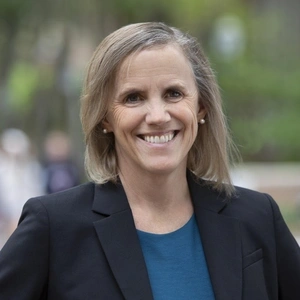
Jennifer Valerio
Associate Director, Urban Teaching Residency Program
After nearly a decade of research and collaboration with Philadelphia schools, the team behind the Responsive Math Teaching (RMT) Project is releasing a book designed to transform math instruction far beyond the city. Becoming a Responsive Mathematics Teacher: Centering Student Thinking in K–8 Classrooms, published December 16 by Routledge, distills years of classroom-based learning into practical tools and guiding principles aimed at helping teachers make math more meaningful, equitable, and student-centered.
“We wanted this work to live on,” said Caroline Ebby, a senior lecturer at Penn GSE and principal investigator for the RMT Project. “When a project ends, it’s sort of sad to think, ‘We did all this great work together and learned so much, and now it’s over.’ So, we thought, why not put it into a book?”
The RMT Project began in 2016 with a planning grant from the William Penn Foundation and expanded with a National Science Foundation award in 2018. Over five years, the team partnered with 15 schools and worked with more than 300 educators across the School District of Philadelphia. Eleven teacher-leaders stayed engaged for the duration, helping to build a networked learning community that supported sustained change.
Unlike traditional professional development, RMT was designed as a long-term, collaborative process. Teachers first experienced math as learners, then practiced responsive teaching strategies in their classrooms, and ultimately grew into leadership roles.
“We knew teachers needed time and support to understand and break down what teaching practice would look like to be responsive,” Ebby said. “It’s hard work. You have to know the math, recognize how kids do math, and develop new skills for eliciting and responding to student thinking rather than just showing them steps.”
What is Responsive Math Teaching? At its core, it shifts the focus from memorizing formulas to making sense of problems. The book lays out RMT’s four guiding principles: Prioritizing mathematical sense-making, promoting collaborative learning communities, supporting positive mathematical identities, and ensuring all students have access to math. Those principles reflect a commitment to equity and engagement.
“We’re asking math teachers to teach using methods that often vary dramatically from the ways they learned math,” said Brittany Hess, one of the book’s co-authors and a research specialist with the Consortium for Policy Research in Education (CPRE) at Penn GSE. “The focus in math class has shifted from getting the correct answer as quickly as possible to problem-solving, collaboration, and much more student voice.”

The book’s structure mirrors the professional development model used during the project. Chapters address key aspects of responsive instruction: launching a task, facilitating productive struggle, discussing learner thinking, connecting and consolidating student learning, building a responsive classroom community, planning for responsive math teaching, and supporting teacher learning. Each chapter includes classroom vignettes drawn from real experiences in Philadelphia schools and practical tools that break down teacher responsibilities into concrete actions.
“One thing that makes our book unique is that we’ve really focused on what the responsibilities of the responsive teacher are—and what they are not,” Ebby said. “Making sense of a problem and deciding on a strategy are the student’s responsibilities. The teacher’s role is to facilitate that process and ensure it aligns with the mathematical goals of the lesson.”
Co-author Lindsay Goldsmith-Markey, a Penn GSE PhD student who led much of the project’s professional development and an adjunct professor at La Salle University, hopes the book will give teachers “concrete tools to begin making shifts toward responsiveness in their instruction” and help administrators understand that these changes “take time, resources, and ongoing supports, like coaching and communities of practice.”
For co-author Jennifer Valerio, now associate director of Penn GSE’s Urban Teaching Residency Program who began work on RMT as her PhD research apprenticeship, the process was a way to synthesize years of learning. “This book is the ‘residue’ of our work together,” she said. “It arms teachers with an ambitious vision of what Responsive Math Teaching looks like but also gives them entry points—small changes they can make that pave the way for larger, more impactful shifts.”
And for co-author Joy Anderson Davis, RMT’s senior instructional coach who now works as a math instructional coach for the School District of Philadelphia, the message is clear: “I hope readers come away with a deep appreciation for the importance and centrality of a healthy, engaged learning community in the development of mathematics learners—whether those learners are children or adults.”
The book was written by the six women who worked together as a team throughout the RMT Project.
“Much like the Responsive Math Teaching research and professional development work itself, this book was a fully collaborative effort,” said Lizzy Pecora, who served as the research project manager for the project while working for CPRE and now works at the Wharton AI and Analytics Initiative. “I co-authored it with five expert and deeply committed colleagues, and we all took on multiple roles—author, editor, reader—throughout the writing process. Together, we worked to capture the core foundations of our work with RMT in a clear and accessible resource for readers. We continuously shared feedback, refined our ideas in conversation with one another, and collaborated closely to ensure the book reflected the collective insights and values that emerged from our years of research and development.”
While the formal project has ended, its influence continues. Many teacher-leaders trained through RMT have moved into leadership roles across the district, spreading the approach in new ways. Ebby hopes the book will amplify that impact: “My dream was that these people we trained would continue to provide PD in their schools. The book is a way to keep that momentum going.”
Planning is underway for book-release celebration early next year, inviting all participating teachers and providing free copies to Philadelphia educators who were part of the project. “We want to celebrate the teachers who made this work possible,” Ebby said.
Media Inquiries
Penn GSE Communications is here to help reporters connect with the education experts they need.